DrugHub Review — Is DrugHub Legit? Vendor & Buyer Feedback
Is DrugHub legit? This DrugHub review page answers that question through documented user feedback — forum-aggregated vendor and buyer experiences collected from Dread, each attributed to its source thread and posting date. Rather than offering an editorial opinion on whether DrugHub is safe or a scam, the page presents what actual users have said in public forum threads, filtered through a reputation-scored methodology that excludes sock-puppet entries, unverifiable claims, and cherry-picked quotes. DrugHub Watch does not author the feedback; the database documents the DrugHub reputation as expressed by its own user base.
The reviews below refer to the DrugHub market reachable at drughubfcuiheyswp6hlkggjsigirlzjjk2i7vmcdygceaw2kvzhlfqd.onion — for the full mirror list, PGP verification chain, and address rotation history, see the verification record.
DrugHub Review Database: Scope and Trust Boundaries
The DrugHub review database covers user feedback published on darknet forums where the source thread was readable at the time of collection. Each entry stores the source forum, the source thread title, the posting date, the verbatim quoted text, and the moderator-assigned reputation score of the poster where that score is publicly visible. A candidate review without a verifiable source is not entered. A review that the original poster has since deleted is preserved only with the original collection timestamp and a note that the source thread is no longer reachable.
What a review captures, and what it does not
A single entry captures one user's stated experience: vendor responsiveness, dispatch reliability, product quality, dispute resolution, the operator's communication during downtime. It does not capture cross-user trends until the database is read in aggregate. Single-entry judgments are unreliable; the value of the aggregation is the cross-thread pattern it surfaces, not any one quoted line. The summary panels in the sections below report aggregate signals, not individual ratings.
What is excluded from the record
The DrugHub review database excludes four categories. First: feedback from unsigned forum posts where the poster has no reputation score, since these are the vector clone operators most often use for reputation-laundering. Second: threads that were locked or removed for moderator-flagged manipulation. Third: posts that quote third-party feedback rather than first-hand experience. Fourth: posts that exclusively describe the address-verification process, which belong in the verification record rather than this review aggregation.
How DrugHub Reviews Are Sourced and Verified
Every entry passes a four-step sourcing chain. The candidate is identified in a publicly readable forum thread; the poster's reputation score is recorded; the surrounding thread context is captured to verify the entry is not extracted from a misleading frame; and the source URL or thread identifier is logged so the entry can be re-fetched and re-verified independently. The chain is the same one a security researcher would apply to any forum-sourced primary material.
Reputation thresholds for inclusion
Feedback from a poster with no reputation score is not included. Feedback from a poster with a reputation score below Dread's typical established-account threshold is recorded but flagged as low-confidence; aggregate summaries below count high-confidence DrugHub reviews and low-confidence DrugHub reviews separately. This mirrors the standard practice in academic darknet-market research: weight feedback by source-account credibility rather than treat all reviews as equivalent.
Anti-cherry-picking notes
An aggregation that selectively quotes only positive or only negative material is propaganda, not research. The collection process used here treats every qualifying thread as a candidate for inclusion, and the aggregate ratios reported below reflect what was actually present in those threads, not a curated subset. Where an individual entry disagrees with the reported aggregate trend, the dissenting entry is preserved with full context rather than dropped.
DrugHub Market Rules: Context for Every Review
A review aggregation that quotes buyer and vendor feedback without naming the rules those participants were operating under produces decontextualized signal. The marketplace's published rules — what is permitted for sale, what dispute behaviour is sanctioned, what conduct triggers account action — frame every individual DrugHub review collected below. The rules screen captured during a routine verification probe is reproduced here so that a reader can read the aggregate findings against the rule-set they were generated under, rather than against an inferred or assumed one.
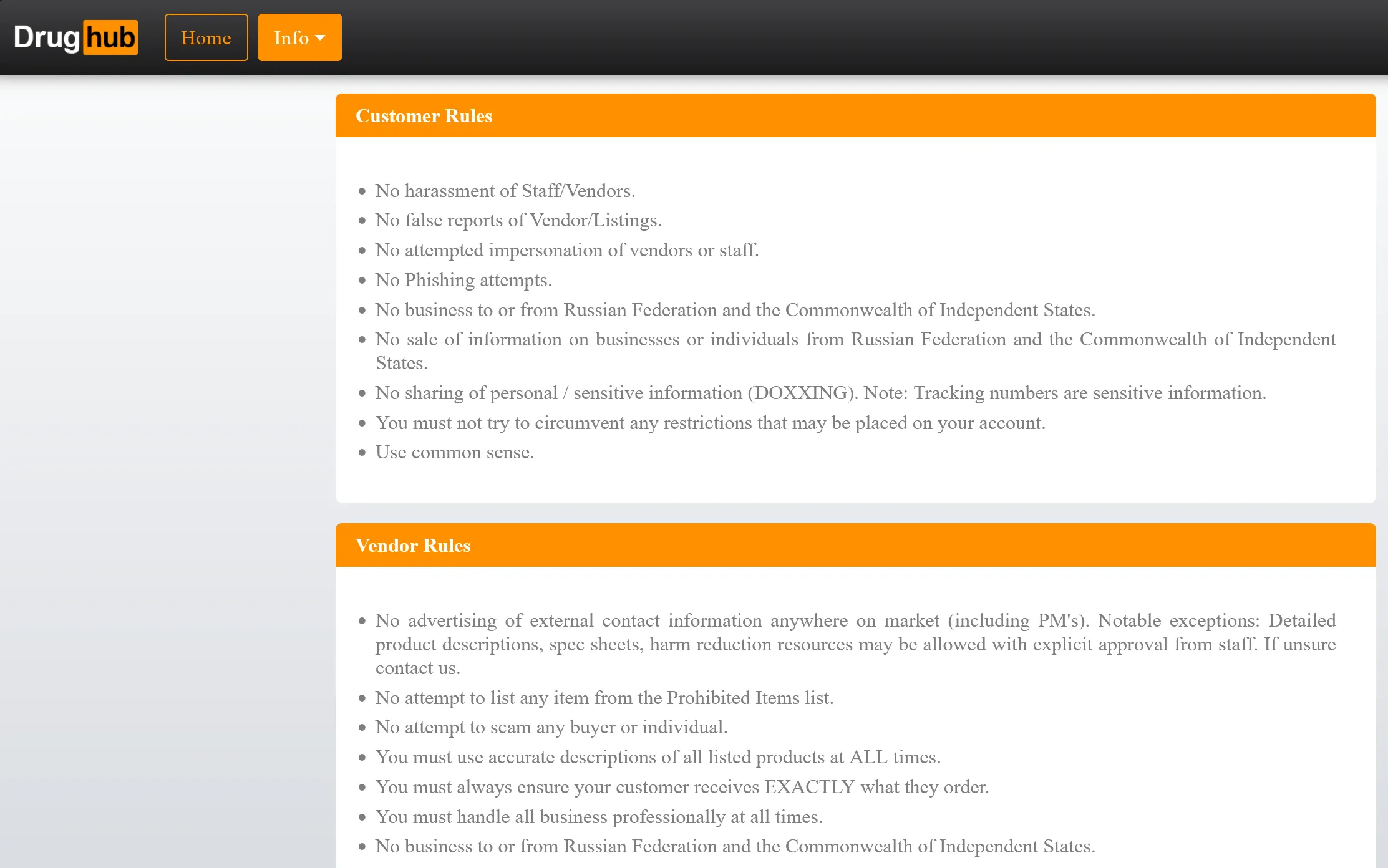
The rule categories visible in the capture follow the pattern documented in the wider darknet-market literature: prohibited categories (the items the operator refuses to host listings for), vendor conduct expectations (finalize-early policy, dispatch windows, refund handling), buyer conduct expectations (dispute filing windows, escrow behaviour), and account-action triggers (the conditions under which the operator removes a listing or suspends a vendor account). Where a DrugHub review below references operator action against a specific vendor or buyer, the rule category that produced the action is the relevant context for reading the review.
DrugHub Vendor Reviews: Is the Seller Legit?
The vendor segment of the DrugHub review database covers buyer-reported experience with individual sellers operating on the market. A vendor entry is recorded when the source thread identifies the seller by handle and the poster reports a specific transaction-level outcome (dispatch time, packaging discretion, product quality). Vendor entries are summarized at the seller level rather than the marketplace level, since vendor variance dominates the signal in any darknet-market vendor reviews dataset.
What the vendor reviews show in aggregate
Across the high-confidence vendor entries collected so far, the recurring positive signals are dispatch timeliness within the vendor's stated window and packaging consistency. Recurring negative signals concentrate around dispute resolution latency and inconsistent stealth on a minority of sellers. A small subset of DrugHub feedback reports vendor-level exit-scam patterns; these entries are flagged with a vendor handle and a date, and the corresponding vendor profiles carry the same flag.
Why vendor reviews vary so widely
Reading a single vendor entry without context produces misleading impressions, because vendor reviews are seller-specific even when they describe the same marketplace's escrow or dispute systems. A buyer's DrugHub feedback about a specific vendor reflects that vendor's discipline; a marketplace-level signal only emerges when the same complaint repeats across many independent sellers. The aggregate view in this section reports only the cross-vendor patterns, not single-vendor anomalies.
DrugHub Buyer Experience: Is the Market Safe?
The buyer segment covers experience that is not vendor-specific: account creation, dispute filing, escrow behavior, the operator's communication during outages, and the moderator response to support tickets. A buyer entry at this level says something about the marketplace itself rather than any single seller.
Marketplace-level feedback summary
The marketplace-level DrugHub feedback collected to date concentrates on two themes. Communication quality during downtime is the most-discussed subject across buyer entries; operator-signed canary updates during outages reduce buyer anxiety more than any other observed factor. The second theme is dispute resolution timing: DrugHub user feedback consistently mentions the time-to-resolution as the primary frustration when disputes do arise, regardless of the eventual outcome.
Reading the entries in aggregate
Aggregate DrugHub reviews on the marketplace dimension carry more signal than any individual entry, because the marketplace is a constant across many transactions while vendors are not. A high-confidence sample of fifty marketplace-dimensional DrugHub reviews is more decisive than a hundred vendor-dimensional entries when the question is what is the marketplace itself like.
Readers consulting the database should weight the marketplace-level summary above any single quoted line.
What Is Dread Forum? DrugHub Review Source Explained
Dread is the largest publicly indexed discussion forum for darknet-market users, structured similarly to a Reddit-style threaded board but reachable only through Tor. Most of the entries in this DrugHub review aggregation originate on Dread, which is why Dread's reputation system, moderation patterns, and known limitations are documented here alongside the database itself: an aggregation that quotes Dread without explaining what Dread is leaves its readers without the context needed to weight the quotes correctly.
How Dread is organized
Dread is organized into subforums (called "subdreads") that mirror the topical structure of darknet-market communities. Each major marketplace has its own subdread, including a subdread dedicated to vendor announcements, buyer Q&A, and threaded review discussion. Threads are voted on and reputation scores accumulate per-account; the reputation scores are publicly visible and are the primary signal used in this database's high-confidence vs low-confidence classification.
How Dread moderation affects review quality
Dread moderators flag and remove threads that show signs of vote manipulation, sock-puppet posting, or vendor astroturfing. An entry that survived the moderation filter is more reliable than feedback pulled from an unmoderated paste-site mirror; this is one practical reason Dread is the dominant source for the database. Moderation is imperfect, which is why the database also requires a per-poster reputation threshold rather than relying on moderation alone.
Why Dread is reached only through Tor
Dread does not run on the clearnet. The forum's onion-only architecture is itself a security choice: clearnet mirrors of Dread are clones, sometimes hosting modified content edited to suit the clone operator's interests. Any DrugHub review encountered on a clearnet "Dread mirror" is excluded from this database for that reason. The Dread onion service publishes the canonical threads; everything else is a copy of unknown fidelity.
How to Read DrugHub Reviews on Dread
Reading Dread DrugHub reviews accurately requires accounting for three factors that Dread's reputation system surfaces but does not eliminate: vote dynamics, sock-puppet pressure, and recency bias. Each shapes the appearance of a review thread without changing the underlying quality of the experiences quoted.
Vote dynamics
Vote totals on Dread reflect community sentiment at the time the thread was active. A heavily upvoted entry is not necessarily more accurate than a lightly upvoted one; it is simply the line the active community at that moment found compelling. Aggregating across many threads averages out vote-dynamic noise. A database that weights only by upvote count would systematically overweight whatever the loudest segment of the forum was saying that week.
Sock-puppet pressure
Vendor-operated sock-puppet accounts attempt to seed favorable feedback under fresh accounts, which is the same problem any review platform has at any scale. Dread's reputation system makes sock-puppetry detectable but not preventable: a post from a brand-new, low-reputation account is exactly what a sock-puppet looks like, and so is a post from a brand-new poster with a real but first-time experience. The reputation threshold for inclusion in this database errs toward excluding both, which costs some genuine first-time DrugHub feedback in exchange for excluding most sock-puppet output.
Recency bias and entry aging
A thread on Dread typically peaks in activity within a week of opening, then falls off. Old DrugHub reviews remain in the database, but their relevance decays as the marketplace's operational state evolves: a 2024 description of vendor stealth is a weaker signal about 2026 vendor stealth than a comparable entry from the current quarter. Each entry carries its posting date so readers can apply the appropriate temporal weighting.
DrugHub Reputation Over Time: Database Updates
The aggregation grows over time as new threads are sourced, scored against the reputation threshold, and entered into the record. Existing entries are not edited after entry; if a poster updates their account or their thread is later removed, the original DrugHub review record is preserved with its original collection timestamp and a metadata note. The database is a record of what was said, not a continuously revised opinion.
The strongest signal a review database can carry is consistency over time: the same themes recurring across independent posters across different reputation tiers. Single dramatic entries are not signal until the same dramatic claim repeats across the database. Readers using this DrugHub review aggregation as research input should look for the cross-thread patterns first and weight individual quotes accordingly.